

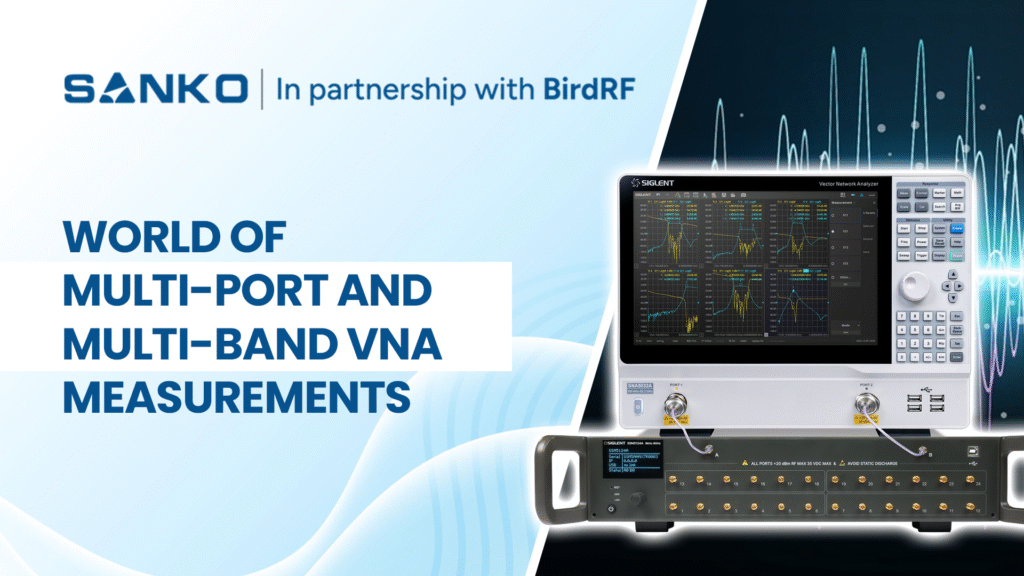
Imagine you’re standing in a high-tech lab in the heart of Singapore’s Jurong Innovation District. You’ve got a cutting-edge 5G MIMO antenna sitting on the bench. In the old days, testing this would have been a gruelling marathon. You’d connect two ports, run a sweep, disconnect, recalibrate, and repeat—over and over until your coffee went cold and your eyes blurred. It was a linear solution for a non-linear world. But today, the vector network analyzer has evolved. We aren’t just looking at X and Y anymore; we’re looking at a multi-dimensional puzzle that requires a sophisticated approach to Multi-Port and Multi-Band measurements.
The shift toward these complex measurements isn’t just a luxury; it’s a survival mechanism for modern RF engineering. As devices shrink and frequencies climb into the millimetre-wave (mmWave) spectrum, the “one port at a time” philosophy has become a bottleneck. By leveraging a multi-port vector network analyzer, engineers are slashing test times by up to 75% while capturing data that single-path setups simply miss—like complex cross-talk and phase-coherent signals.
The Complexity Crisis in Modern RF
When we talk about “Multi-Port,” we’re referring to systems that go beyond the traditional two-port S-parameter measurements. Think about a modern smartphone; it’s packed with filters, duplexers, and switch matrices. If you’re testing a 4×4 MIMO system, a standard two-port sweep is like trying to map an entire city by looking through a straw. You lose the context of how port 1 interacts with port 4 while port 2 is active.
Multi-band measurements take this a step further. We are no longer operating in isolated silos of “just Sub-6GHz” or “just Ka-band.” Modern aerospace and telecommunications hardware must jump between these bands seamlessly. This requires a vector network analyzer capable of sweeping across massive frequency spans without losing dynamic range or requiring a dozen different hardware reconfigurations.
The stakes are high. According to recent industry reports, the global RF test equipment market is projected to reach USD 5.11 billion by 2028, driven largely by the push for 5G-Advanced and early 6G research (Source: Fortune Business Insights). In a market this competitive, the efficiency of your test bench is your greatest asset.
When you’re looking to upgrade your lab capabilities, finding the right partner is crucial. For those navigating the local landscape, Sanko’s RF Test and Measurement in Singapore offers the specific hardware expertise needed to bridge the gap between theoretical specs and real-world bench performance.
Why Multi-Port Systems are a Game Changer
In the traditional workflow, “throughput” was a dirty word in the lab. You could have precision, or you could have speed, but rarely both. Multi-port VNAs changed the math. By using a single setup to characterise all paths of a multi-port device (DUT), you eliminate the cumulative error introduced by repeated manual connections.
Every time a technician touches a cable, there is a risk of connector wear, cable flex error, and inconsistent torque. In a 16-port measurement scenario, the “human error” variable becomes a statistical nightmare. A multi-port vector network analyzer automates this, ensuring that the reference plane stays consistent across all measurements.
| Feature | Single/Dual Port VNA | Multi-Port VNA (4+ Ports) |
| Test Throughput | Low (Sequential) | High (Simultaneous/Automated) |
| Accuracy | High (but prone to connection wear) | Superior (Stable Reference Plane) |
| Cross-talk Analysis | Extremely Difficult | Native Capability |
| Calibration Complexity | Simple but Repetitive | Advanced (requires E-Cal) |
Understanding the nuances of these systems requires more than just reading a manual; it requires a pulse on the industry. Companies like Sanko have become integral to the Singaporean ecosystem by providing the localised support and high-end instrumentation that local R&D hubs require to stay globally relevant.
The Multi-Band Advantage: Seeing the Big Picture
We’ve all been there: you finish a sweep in the X-band, only to realise the harmonic interference is leaking into a completely different spectrum. Multi-band VNA measurements allow for a holistic view of the device’s performance. Instead of stitching together data from three different instruments, a wideband vector network analyzer provides a single, continuous trace.
This is particularly vital for wideband components like Gallium Nitride (GaN) power amplifiers. These components often exhibit memory effects and non-linearities that span several GHz. If you aren’t measuring the “out-of-band” behaviour simultaneously with the “in-band” performance, you’re essentially flying blind.
Implementing the Setup: More Than Just Cables
Implementation is where most engineers hit a wall. You can’t just plug in 16 cables and hit “Run.” Calibration becomes the most critical—and time-consuming—step. This is where Electronic Calibration (ECal) modules become non-negotiable. A manual Short-Open-Load-Thru (SOLT) calibration on a 4-port system takes minutes; on a 24-port system, it would take a whole afternoon.
Moreover, cable management becomes a thermal and mechanical challenge. In high-precision environments, even the heat from your hands or the air conditioning cycling on can shift the phase of a high-frequency cable. Professional setups use phase-stable cables and specialised test fixtures to ensure that what the vector network analyzer sees is the device, not the environment.
Success in these implementations often boils down to the quality of the equipment and the local support available to maintain it. In the fast-paced Singaporean tech sector, Sanko provides the essential backbone for RF testing, ensuring that labs aren’t just equipped, but optimised for the next generation of wireless standards.
Data Integrity and Cross-Talk Insights
One of the most profound benefits of multi-port testing is the ability to measure Total S-Parameters. True Differential Stimulus involves driving two ports simultaneously with signals that are 180 degrees out of phase. This is how modern high-speed digital lines actually work. If you only test one line at a time and mathematically “calculate” the differential response, you miss the physical reality of how the electromagnetic fields interact between the traces.
| Measurement Type | Data Insight Provided | Why It Matters |
| Differential S-Parameters | Mixed-mode analysis | Essential for high-speed data (USB4, PCIe Gen6) |
| Pulse Profile | Time-domain behaviour | Critical for Radar and EW applications |
| Noise Figure | Signal-to-noise degradation | Key for satellite and LNA design |
Recent data suggests that the demand for high-speed data transmission is growing at a CAGR of 25%, forcing even “traditional” RF engineers to think like high-speed digital designers (Source: Cisco Annual Internet Report). This convergence is exactly where the multi-port vector network analyzer shines.
Navigating this convergence requires a partner who understands both the legacy RF requirements and the future of digital integration. Sanko continues to lead the charge in Singapore, offering solutions that don’t just measure signals but provide the insight needed to perfect them.
Overcoming the “Calibration Fatigue”
Let’s talk about the “Elephant in the Room”: Calibration. The more ports you have, the more “Thrus” you need. For an N-port VNA, a full calibration requires characterising N(N-1)/2 through connections. For a 12-port system, that’s 66 through connections!
The solution lies in “Unknown Thru” calibration algorithms and multiport ECal modules. These allow the engineer to connect a single module, and the vector network analyzer handles the switching internally. This reduces the “touch time” and significantly lowers the chance of a bad connection ruining a three-hour calibration session.
Conclusion: The Future of RF is Multi-Dimensional
As we look toward the horizon of 6G and ubiquitous IoT, the complexity of RF components will only increase. We are moving toward a world where the vector network analyzer is no longer a standalone “box,” but a centralised hub for multi-dimensional data acquisition. Implementing multi-port and multi-band strategies isn’t just about saving time; it’s about achieving a level of precision that allows for the next leap in communication technology.
In Singapore, where the push for a “Smart Nation” drives constant innovation, having access to world-class RF test and measurement equipment is the difference between leading the market and playing catch-up. For years, Sanko has been the trusted name for engineers who refuse to compromise on accuracy and efficiency.
If you are ready to elevate your testing capabilities and move beyond the limitations of traditional VNA setups, it’s time to consult with the experts. Don’t let outdated measurement techniques hold back your innovation. Explore the full range of advanced solutions and expert consultancy at Sanko RF Test and Measurement to see how we can transform your lab’s throughput.
Ready to take the next step in RF precision? Contact our specialist team at Sanko today, and let’s build the future of connectivity together!
 English
  Chinese
  Korean
  Japanese
  Spanish