

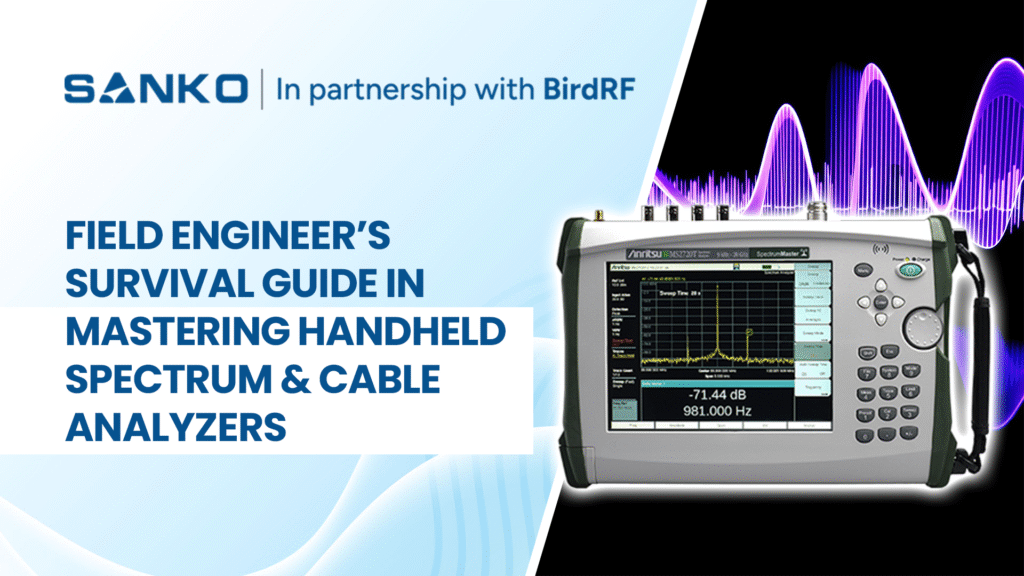
Picture this: You’re standing on a rooftop in the heat of a Dubai afternoon, the sun reflecting off the glass of the Burj Khalifa in the distance. Below you, the city is a hum of 5G signals, satellite downlinks, and private radio networks. Your task? Finding a “ghost” interference signal that’s dropping calls for a major telecom provider. In this environment, your benchtop gear back at the lab is useless. You need precision that you can carry in one hand.
This is the reality for the modern RF professional. The transition from controlled lab environments to the unpredictable “wild” of the field has turned the handheld spectrum analyzer and the handheld cable and antenna analyzer from optional accessories into primary weapons. Whether you are validating a new small cell installation or troubleshooting a VSWR (Voltage Standing Wave Ratio) spike on a remote tower, the gear you carry determines whether you go home early or stay through the night.
The Rise of Field-Centric RF Testing
The UAE has become a global testbed for ultra-fast connectivity. With 5G penetration hitting record highs and the push toward 6G research already in motion, the RF environment is more “crowded” than ever. According to industry data, the global spectrum analyzer market is projected to reach approximately USD 3.33 billion by 2034, with the handheld segment growing at a rapid CAGR of 8.38% (Source: SNS Insider).
This growth isn’t just about more devices; it’s about the complexity of the signals. We are no longer just looking at simple sine waves. We are analysing complex modulation, beamforming, and millimetre-wave (mmWave) frequencies that require instruments with high dynamic range and low noise floors, all packed into a rugged, battery-powered chassis.
When your mission is critical, the source of your equipment matters as much as the specs. For professionals operating in the region, Sanko RF Test and Measurement in UAE provides the localised support and high-tier instrumentation necessary to handle the unique climatic and technical demands of the Middle Eastern RF landscape.
Handheld Cable and Antenna Analyzer: The First Line of Defence
If the spectrum analyzer is the “eyes” of an engineer, the analizador de cables y antenas portátil is the “stethoscope.” Most field issues aren’t actually signal-related—they are physical. A loose connector, a crimped coaxial cable, or moisture ingress in an antenna housing can wreak havoc on system performance.
Using a specialised tool like a Handheld Cable and Antenna Analyzer allows you to perform “Distance-to-Fault” (DTF) measurements. Instead of guessing where a cable is damaged, the instrument tells you exactly how many meters down the line the reflection is occurring. This is a game-changer when you’re dealing with cables running hundreds of feet up a broadcast tower.
| Measurement Type | Primary Insight | Critical For… |
| Return Loss / VSWR | Efficiency of power transfer | Preventing transmitter damage |
| Cable Loss | Signal attenuation over distance | Ensuring the signal reaches the antenna |
| Distance-to-Fault (DTF) | Physical location of cable breaks | Rapid physical repairs |
Handheld Spectrum Analyzer: Hunting the Invisible
Once you’ve verified that your physical infrastructure is “green,” you move to the airwaves. A handheld spectrum analyzer is designed to visualise the invisible. In the UAE’s dense urban centres, interference is the number one enemy. Illegal repeaters, poorly shielded industrial equipment, or even “spectral regrowth” from neighbouring bands can degrade a network’s Quality of Service (QoS).
Modern units, such as those found in the Sanko Analizador de espectro portátil lineup, offer real-time spectrum analysis (RTSA). This is crucial because many modern interference signals are “bursty”—they appear and disappear in milliseconds. A traditional swept-tuned analyzer might miss them entirely, but an RTSA-capable handheld captures every transient, allowing you to see the “hidden” signals that cause dropped packets.
The efficiency of your field operations directly impacts your bottom line. In the Middle East, Sanko, has established a reputation for bridging the gap between high-end technical requirements and the practical realities of field deployment, ensuring your team has the right tool for the specific job at hand.
Choosing the Right Tool: A Comparison
One common mistake is assuming one tool can do everything. While “all-in-one” combo analysers exist, specialised tools often provide better battery life, lower weight, and more intuitive interfaces for specific tasks. For instance, a dedicated cable analyzer is often more ruggedised for the physical “abuse” of tower climbing, while a spectrum analyzer might prioritise screen visibility in direct sunlight and high-frequency sensitivity.
Recent statistics show that hardware still dominates the test and measurement market, accounting for nearly 69% of the market share because of the intrinsic need for physical, high-accuracy measurement at the site (Source: Fortune Business Insights).
| Factor | Cable & Antenna Analyzer | Spectrum Analyzer |
| Primary Goal | Physical Layer Integrity | Spectral Environment Analysis |
| Key Metric | VSWR, Return Loss, DTF | Power, Frequency, Occupied Bandwidth |
| Typical Use Case | Installation & Maintenance | Interference Hunting & Optimisation |
| Output Type | Reflection (S11) | Power vs. Frequency |
Effective field testing is about more than just owning a device; it’s about a relationship with a partner who understands the local regulatory environment and the nuances of the regional spectrum. Sanko doesn’t just sell boxes; they provide the technical backbone for engineers working on the UAE’s most ambitious infrastructure projects.
The Impact of 5G and mmWave on Handheld Gear
As we move into the FR2 (mmWave) bands, the margin for error disappears. At 28 GHz or 39 GHz, even a fingerprint on a connector or a slight bend in a cable can cause significant signal loss. Handheld tools now need to support these higher frequencies while maintaining the portability that field engineers require.
The transition to 5G has increased the demand for RF test equipment significantly, as the higher frequencies require a denser deployment of small cells. This “densification” means more sites to test, more cables to validate, and a much higher chance of inter-cell interference.
Practical Tips for Field Measurements
- Warm-up Time: Even handheld units need a few minutes to stabilise their internal oscillators for maximum frequency accuracy.
- Calibrate at the End of the Cable: When using a handheld cable and antenna analyzer, always perform your calibration at the end of the test lead, not at the instrument port. This “zeros out” the effect of the test cable itself.
- Watch the DANL: When hunting for weak interference with a handheld spectrum analyzer, ensure your attenuation is set low to keep the Displayed Average Noise Level (DANL) as low as possible.
Conclusion: Engineering Excellence in Every Pocket
The world of RF is no longer confined to the laboratory. The future of connectivity is being built, tuned, and repaired in the field—on the tops of skyscrapers, in the middle of deserts, and inside crowded stadiums. By mastering the use of the handheld spectrum analyzer and the handheld cable and antenna analyzer, engineers are ensuring that the digital world remains fast, reliable, and secure.
For those looking to equip their teams with the best in class, Sanko remains the premier choice. With a deep understanding of RF dynamics and a commitment to providing localised expertise, we ensure your measurements are accurate, every time.
Don’t leave your network’s performance to chance. Whether you need to troubleshoot a complex interference issue or validate a multi-site installation, our team of experts is ready to assist. Contact Sanko RF Test and Measurement today to discover how our handheld solutions can streamline your field operations and give you the competitive edge in the evolving tech landscape!
 Spanish
  English
  Chinese
  Korean
  Japanese