

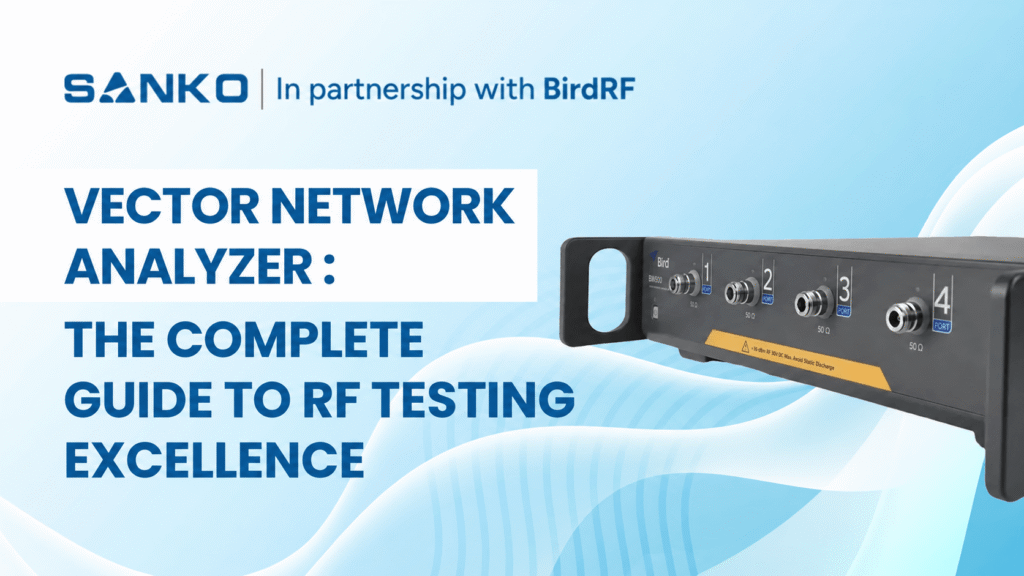
El avance de la tecnología de radiofrecuencia (RF) requiere instrumentos de medición precisos que puedan mantenerse al día con sistemas de comunicación cada vez más complejos. Liderando esta progresión tecnológica se encuentra el analizador vectorial de redes, un instrumento de alto rendimiento que ahora es omnipresente en las últimas aplicaciones de ingeniería y pruebas de RF.
¿Qué es un analizador de redes vectoriales?
Vector Network Analyzer (VNA) is a radio frequency (RF) test instrument that measures both the amplitude and phase of high-frequency signals as they reflect from or pass through a device under test (DUT).
It applies a known RF stimulus and measures reflection and transmission as S-parameters, including S11 and S21. Engineers use these results to evaluate antenna matching, filter insertion loss, amplifier gain and cable performance. Accurate measurements require calibration at the DUT connection point.
El avance de la tecnología de radiofrecuencia (RF) requiere instrumentos de medición precisos que puedan mantenerse al día con sistemas de comunicación cada vez más complejos. Liderando esta progresión tecnológica se encuentra el analizador vectorial de redes, un instrumento de alto rendimiento que ahora es omnipresente en las últimas aplicaciones de ingeniería y pruebas de RF.
Comprendiendo los Analizadores de Redes Vectoriales: Más allá de las Mediciones Básicas de RF
A vector network analyzer measures a device’s complex reflection and transmission response across frequency. Unlike a scalar network analyzer, which measures magnitude, a VNA also measures phase. This information helps engineers assess impedance matching, gain, loss and delay in RF components and systems.
In antennas, communications systems and RF circuits, amplitude and phase relationships help explain component performance. Vector measurements support research and development, production testing and suitable field-service applications, depending on the instrument and test setup.
Los analizadores de redes actuales son muy adecuados para la medición de parámetros S, que describen cómo responden las redes eléctricas a señales en varias frecuencias. Esta medición se utiliza para caracterizar elementos pasivos como filtros, acopladores y antenas, así como componentes activos como amplificadores y mezcladores.
How Does a Vector Network Analyzer Work?
The VNA generates a controlled signal and sweeps it across a selected frequency range. Directional couplers separate incident, reflected and transmitted waves. Receivers compare these waves with a reference, and the instrument calculates the DUT’s magnitude and phase response.
The process follows four steps:
- Generate a known RF stimulus.
- Apply the stimulus to the DUT.
- Measure incident, reflected and transmitted signals.
- Calculate and display the response across frequency.
Understanding S11, S21, S12 and S22
S-parameters describe how signals reflect from or travel through a device. For a two-port DUT, four main parameters describe matching and transmission in both directions.
| Parámetro | Measurement | Typical use |
| S11 | Input reflection | Antenna matching and input return loss |
| S21 | Forward transmission | Filter loss, cable loss and amplifier gain |
| S12 | Reverse transmission | Reverse isolation or transmission |
| S22 | Output reflection | Output matching and return loss |
For a passive filter, S21 shows the transmitted signal across the passband and stopband. S11 shows input reflection. Reviewing both helps distinguish poor matching from other causes of transmission loss.
Aplicaciones del Analizador Vectorial de RF en Diversas Industrias
El analizador de redes vectoriales de RF ha encontrado una adopción generalizada en múltiples industrias, cada una aprovechando sus capacidades únicas para aplicaciones específicas. En telecomunicaciones, estos instrumentos son esenciales para diseñar y probar equipos de estaciones base, asegurando características óptimas de transmisión y recepción de señales. La creciente complejidad de las tecnologías 5G y emergentes 6G ha incrementado aún más la demanda de soluciones de medición RF de alto rendimiento.
Las aplicaciones aeroespaciales y de defensa dependen en gran medida de los analizadores de redes vectoriales RF para el desarrollo de sistemas de radar, la prueba de equipos de comunicación satelital y la caracterización de sistemas de guerra electrónica. Son esenciales para el análisis de componentes de radiofrecuencia (RF) y microondas de diversos dispositivos pasivos y activos, incluidos filtros, antenas y amplificadores de potencia.
The automotive industry has become another significant user of RF vector network analyzers, particularly with the advancement of connected vehicle technologies, automotive radar systems, and vehicle-to-everything (V2X) communication protocols. These applications require precise RF component characterisation to ensure reliable performance in challenging automotive environments.
El auge de los analizadores vectoriales de red USB: precisión portátil
A USB vector network analyzer uses a connected computer for its interface and measurement control. Professional PC-controlled models can support demanding RF measurements while reducing the space occupied by dedicated instrument displays and controls.
USB connectivity does not determine accuracy, frequency range or suitability. Professional laboratory instruments and hobbyist VNAs can differ considerably. Compare the specifications, calibration capabilities and supported measurements of the particular model.
Los analizadores de redes vectoriales USB generalmente se conectan a computadoras personales estándar a través de interfaces USB, aprovechando la potencia de procesamiento y las capacidades de visualización de las PC modernas. Este enfoque reduce los costos del instrumento, al tiempo que proporciona a los usuarios interfaces familiares y amplias capacidades de procesamiento de datos mediante aplicaciones de software especializadas.
Portability depends on the complete setup, including the computer, power supply, cables and calibration accessories. For outdoor work, check battery operation, environmental limits and ruggedness rather than assuming every USB VNA is field-ready.
Principales Ventajas de los Analizadores de Redes Vectoriales USB
- Compact size – Saves bench space.
- PC integration – Simplifies viewing and saving results.
- Programmable control – Supports repeated test sequences
- Portable arrangement – Can move between workstations
- Software options – Can enable supported analysis functions
Especificaciones Técnicas y Métricas de Rendimiento
VNA specifications should be compared under conditions that reflect your application. Dynamic range, trace noise and speed depend on frequency, configuration and measurement settings. A headline figure does not describe performance in every operating condition.
| Specification | Why it matters | What to confirm |
| Rango de frecuencia | Defines the bands you can measure | Required start and stop frequencies |
| Port count | Defines available measurement paths | Reflection, transmission or multiport needs |
| Rango dinámico | Supports measurement of weak transmission | Performance at the required frequencies and settings |
| Trace noise | Affects small response changes | Specified IF bandwidth and averaging |
| Source power | Sets the stimulus applied to the DUT | Suitable range and adjustment capability |
| Velocidad de medición | Affects test throughput | Sweep time at the required accuracy |
| Calibration support | Establishes the reference plane | Suitable standards and methods |
IF bandwidth controls part of the receiver’s noise-versus-speed trade-off. A narrower setting can reduce noise but usually increases measurement time. Choose settings based on whether you need fast production screening or detailed component characterisation.
Frequency coverage varies widely among USB and benchtop VNAs. Some professional PC-controlled models reach microwave bands, while others serve lower-frequency applications. Check the datasheet and required options rather than choosing by instrument format alone.
Calibración y Precisión de Medición
Para lograr mediciones precisas con cualquier analizador de redes vectorial, se requieren procedimientos de calibración adecuados que tengan en cuenta los errores sistemáticos en el sistema de medición. Un analizador de redes vectorial alcanza medidas altamente precisas corrigiendo los errores sistemáticos en el instrumento, las características de los cables, adaptadores y accesorios de prueba.
Los procedimientos estándar de calibración incluyen la calibración Short-Open-Load-Through (SOLT) para mediciones coaxiales y la calibración Through-Reflect-Line (TRL) para aplicaciones especializadas. Los instrumentos modernos a menudo incluyen rutinas de calibración automatizadas que simplifican este proceso crítico al tiempo que garantizan la repetibilidad y precisión de las mediciones.
Calibration establishes a measurement reference plane. When a cable connects the VNA to the DUT, calibrating at the cable’s end helps account for its effects. Anything added beyond that reference plane can still influence the measured result.
| Calibration approach | Typical application |
| One-port open, short and load | Antenna reflection and input matching |
| Full two-port SOLT | Coaxial reflection and transmission measurements |
| TRL | Suitable fixture, transmission-line or on-wafer testing |
| Electronic calibration | Simplifying calibration with a compatible module |
Calibration reduces systematic errors but cannot eliminate every source of uncertainty. Noise, connector repeatability and changes after calibration can remain. Keep cables stable and use a suitable verification device to check that the setup behaves as expected.
Reassess calibration after changing cables, adapters or the test arrangement. Confirm that calibration standards match the connector type and frequency range. Calibration kits and electronic modules may be separate purchases.
For a deeper explanation, read our guide to practical VNA calibration and measurement techniques.
Vector Network Analyzer Tutorial: Your First Measurement
Begin with a simple task, such as antenna reflection or transmission through a cable. Define the operating band and the result you need before choosing the settings.
- Prepare the setup. Inspect connectors, select suitable cables and follow the manufacturer’s stabilisation guidance.
- Set the sweep. Choose start and stop frequencies covering the DUT’s operating band.
- Select the measurement. Use S11 for input reflection or S21 for forward transmission.
- Set test conditions. Choose appropriate source power, measurement points and IF bandwidth.
- Calibrate. Establish the reference plane at the intended DUT connection point.
- Connect and measure. Keep the calibrated arrangement stable.
- Review and save. Use markers to examine key frequencies and record settings with the results.
For transmission testing, connect the DUT between two test ports. For a simple antenna reflection measurement, connect the antenna at the calibrated port or cable end. Follow instrument and DUT limits, especially when testing active components.
Vector Network Analyzer Antenna Measurement
A VNA measures an antenna’s input reflection to evaluate impedance matching across frequency. Common displays include S11, return loss, VSWR and the Smith chart. Calibrate at the antenna connection point and measure across the intended operating band.
| Measurement | What it tells you |
| S11 | Reflection from the antenna input |
| Return loss | Reflected signal level relative to the incident signal |
| VSWR | Degree of impedance mismatch |
| Smith chart | Resistance and reactance across frequency |
| Impedance bandwidth | Frequency range meeting a defined matching limit |
For a passive antenna, a more negative S11 magnitude in dB means less reflection. Return loss expresses this relationship as a positive value. For example, S11 of −20 dB corresponds to 20 dB return loss.
| S11 magnitude | Return loss | Reflected power | Approximate VSWR |
| −10 dB | 10 dB | 10% | 1.92:1 |
| −15 dB | 15 dB | 3.20% | 1.43:1 |
| −20 dB | 20 dB | 1% | 1.22:1 |
These relationships follow the standard return-loss and VSWR calculations.
Use the antenna or system specification to decide whether a result is acceptable. These values describe matching, not a universal pass/fail threshold.
Good matching alone does not establish antenna gain, radiation pattern or efficiency. An antenna can accept power while losing some of it rather than radiating effectively. Those characteristics require additional measurements and a suitable antenna test arrangement.
The enclosure, mounting position and nearby objects can change antenna impedance. Test under conditions that represent the intended installation and keep the arrangement consistent when comparing results.
Integración con sistemas de prueba modernos
Los entornos contemporáneos de prueba de RF exigen cada vez más instrumentos que puedan integrarse perfectamente con equipos de prueba automatizados (ATE) y sistemas de línea de producción. Los analizadores de red vectorial USB sobresalen en estas aplicaciones debido a sus interfaces informáticas estándar y sistemas de control basados en software.
Both benchtop and PC-controlled VNAs may support automation. Check the model’s control interface, commands, drivers and software licences. Manufacturing plug-ins and advanced test functions are model-specific rather than standard features of every VNA.
Las interfaces de programación, incluyendo la compatibilidad con SCPI (Comandos Estándar para Instrumentos Programables), permiten a los ingenieros desarrollar secuencias de prueba personalizadas e integrar las mediciones del analizador de redes vectoriales en procedimientos más amplios de validación del sistema. Esta capacidad de programación extiende la utilidad de estos instrumentos más allá de las mediciones básicas hacia una caracterización integral del sistema.
Before automating, establish a repeatable manual measurement and define:
- Calibration and verification procedures.
- Sweep settings, source power and test limits.
- DUT identification and result storage.
- Actions for failed measurements or lost connections.
Comparación con analizadores de banco tradicionales
Choose the instrument format around the working environment and required measurements. Benchtop, USB and handheld VNAs can serve professional applications, but their capabilities vary by model.
| Parámetro | Benchtop VNA | USB or PC-controlled VNA |
| Interfaz | Usually integrated display and controls | Host computer and software |
| Bench space | Dedicated instrument footprint | Compact hardware plus computer |
| Rendimiento | Depends on the model and options | Depends on the model and options |
| Portabilidad | Depends on size and power needs | Depends on the complete setup |
| Automation | Available on supported models | Available on supported models |
| Upgrades | Hardware and software options vary | Hardware and software options vary |
Compare total setup cost, supported measurements and specified accuracy. Neither lower cost nor equivalent performance follows automatically from USB connectivity. Software upgrades can enable supported functions but cannot remove fundamental hardware limits.
VNA vs Spectrum Analyzer vs Antenna Analyzer
| Instrument | Main purpose | Example task |
| Vector network analyzer | Measures a DUT’s response to a known stimulus | Filter loss and antenna matching |
| Spectrum analyzer | Examines signal power across frequency | Interference and unwanted emissions |
| Cable and antenna analyzer | Supports installation and maintenance measurements | Feedline matching and fault location |
Some instruments combine these functions. Spectrum analyzers with tracking generators can perform certain response measurements, but phase measurement and calibration capabilities differ. Confirm which functions the instrument supports.
For field-testing considerations, see our guide to handheld spectrum and cable analyzers.
Tendencias Futuras y Avances Tecnológicos
El mercado de analizadores de redes vectoriales continúa evolucionando con los avances en los requisitos tecnológicos y la aparición de nuevas aplicaciones. La mayor cobertura de frecuencia, la mejora del rango dinámico y el aumento de la velocidad de medición representan prioridades de desarrollo constantes en toda la industria.
For buyers, practical developments include wider frequency coverage, multiport testing and stronger software integration. Assess each capability against your project rather than relying on broad claims about future technologies.
Software can expand supported analysis and automation functions. However, frequency coverage, receiver performance and other hardware characteristics still define the instrument’s measurement limits.
How to Choose a High-Frequency Network Analyzer for 6G R&D
Begin with the research band, DUT and required measurement. Different 6G research projects need different systems. A “6G-ready” description alone does not establish suitability.
- Frequency coverage: Confirm calibrated operation across the research band.
- Extension capability: Check whether compatible frequency extenders are required.
- Connections: Assess suitable connectors, waveguides or probes.
- Calibration: Establish the reference plane at the DUT.
- Performance: Check dynamic range and uncertainty at the intended frequencies.
- Measurement scope: Decide whether S-parameters are sufficient or additional instruments are needed.
Advanced component testing may involve a VNA, frequency extenders, controllers and signal-generation hardware. Evaluate the complete measurement system, including calibration and accessories, rather than the analyzer’s maximum frequency alone.
Selección del Analizador de Redes Vectoriales adecuado para su aplicación
Elegir un analizador de redes vectoriales adecuado requiere una cuidadosa consideración de varios factores clave, incluidos los requisitos de rango de frecuencia, especificaciones de rango dinámico, configuraciones de puerto y limitaciones presupuestarias. La decisión entre soluciones tradicionales de sobremesa y basadas en USB depende en gran medida de los requisitos específicos de la aplicación y las limitaciones operativas.
For field testing, assess battery operation, ruggedness and the full setup’s portability. For laboratory and production work, prioritise measurement performance, repeatability and automation. A USB VNA can be suitable when its specifications and working arrangement match these requirements.
Las instituciones educativas prefieren cada vez más los analizadores de redes vectoriales USB debido a su combinación de rendimiento profesional y precios accesibles. Estos instrumentos brindan a los estudiantes una experiencia práctica utilizando los mismos principios de medición empleados en la ingeniería profesional de RF, ajustándose a los presupuestos educativos típicos.
| Aplicación | Requirements to assess |
| Antenna matching | Operating band, reflection accuracy and one-port calibration |
| Cable and filter testing | Two-port capability, transmission accuracy and dynamic range |
| Amplifier testing | Source power, receiver limits and supported active-device functions |
| PCB components | Fixtures, calibration access and de-embedding |
| Multiport devices | Port count, switching arrangement and calibration workflow |
| Production testing | Speed, repeatability and programmable control |
Include calibration standards, suitable cables, adapters, software and any host computer in the quotation. Confirm which functions are included and which require additional licences or hardware.
For devices with several signal paths, explore multi-port and multi-band VNA measurements. For fixture-connected DUTs, read about VNA fixture simulation and de-embedding.
Common VNA Measurement Problems
Unexpected results can come from the DUT, test arrangement or settings. Check the setup before deciding that a component has failed.
- Trace changes when a cable moves – Cable stability, connector condition and calibration validity
- Results differ after reconnection – Connection repeatability and connector handling
- PCB component shows unexpected loss Fixture effects and reference-plane placement
- Noisy measurement trace IF bandwidth, averaging and received signal level
- Good antenna matching but poor range Feedline loss, radiation performance and interference
- Deep filter rejection reaches a flat floor Noise floor, leakage and available dynamic range
Where supported, time-domain analysis can help locate cable discontinuities. Distance-to-fault results also depend on settings such as cable velocity factor. Read our guide to distance-to-fault testing with a VNA.
Sanko: Su socio de confianza en soluciones de pruebas de RF
When it comes to sourcing high-quality vector network analyzers and RF testing equipment, we are a reliable partner for engineers and organisations worldwide. Our comprehensive product portfolio includes both traditional benchtop and cutting-edge USB vector network analyzers from leading manufacturers, ensuring that our customers have access to the most advanced measurement technologies available.
Entendemos que los proyectos exitosos de RF dependen de mediciones precisas y de instrumentos confiables. Nuestros expertos técnicos trabajan en estrecha colaboración con los clientes para identificar las soluciones óptimas de analizadores vectoriales de red para sus aplicaciones específicas, ya sea en laboratorios de investigación, instalaciones de producción o entornos de pruebas de campo.
Nuestro compromiso va más allá de la venta de productos e incluye soporte técnico integral, servicios de calibración y programas de capacitación que ayudan a los clientes a maximizar su inversión en equipos de prueba RF. Este enfoque holístico asegura que nuestros clientes puedan alcanzar sus objetivos de medición de manera eficiente y precisa.
Preguntas frecuentes
Is an RF Network Analyzer the Same as a VNA?
An RF network analyzer is a broader description. A vector network analyzer measures magnitude and phase, while a scalar network analyzer measures magnitude. Check the supported measurements when comparing equipment.
Can a USB Vector Network Analyzer Replace a Benchtop VNA?
It can when its frequency coverage, accuracy, ports and measurement functions meet the application. USB describes the connection and working arrangement. Compare specific models and complete setups before choosing.
Can a VNA Locate a Fault in a Cable?
Some VNAs support time-domain or distance-to-fault measurements. These functions use reflection data to help locate discontinuities. Availability and setup requirements depend on the instrument and installed options.
Does Good Antenna Matching Guarantee Good Performance?
No. Return loss and VSWR describe matching, but do not establish gain, radiation efficiency or coverage. Additional testing may be necessary to assess the antenna’s overall performance.
What Information Should I Provide When Requesting a VNA Quotation?
Provide the DUT type, operating frequencies, required ports, measurements, accuracy needs and expected test volume. Include the working environment and existing accessories. This helps identify suitable vector network analyzer solutions and equipment for a complete setup.
Potencie hoy sus capacidades de prueba RF de Sanko
El panorama de la ingeniería de radiofrecuencia (RF) continúa evolucionando a un ritmo sin precedentes, impulsado por el avance de las tecnologías inalámbricas, el aumento de los requisitos de frecuencia y las crecientes demandas de rendimiento. Ya sea que esté desarrollando sistemas de comunicación de próxima generación, diseñando componentes RF de precisión o manteniendo infraestructuras inalámbricas críticas, el analizador de redes vectoriales adecuado puede marcar la diferencia entre el éxito y la dificultad en sus proyectos.
No permita que equipos de medición obsoletos limiten su potencial de innovación. Explore nuestra amplia selección de analizadores de redes vectoriales, desde soluciones USB compactas perfectas para pruebas de campo hasta sistemas de alto rendimiento diseñados para las aplicaciones más exigentes. Nuestro equipo de expertos está listo para ayudarle a identificar la solución de medición ideal que se ajuste a sus requisitos técnicos, restricciones presupuestarias y objetivos de desempeño.
¿Listo para revolucionar tus capacidades de prueba de RF? Contáctenos descubrir cómo nuestras soluciones de vector network analyzer de última generación pueden acelerar sus proyectos, mejorar sus mediciones y brindarle la ventaja competitiva que necesita en el dinámico mercado de RF actual. Su próximo gran avance está a solo una medición de distancia.
 Spanish
 English
 Chinese
 Korean
 Japanese