

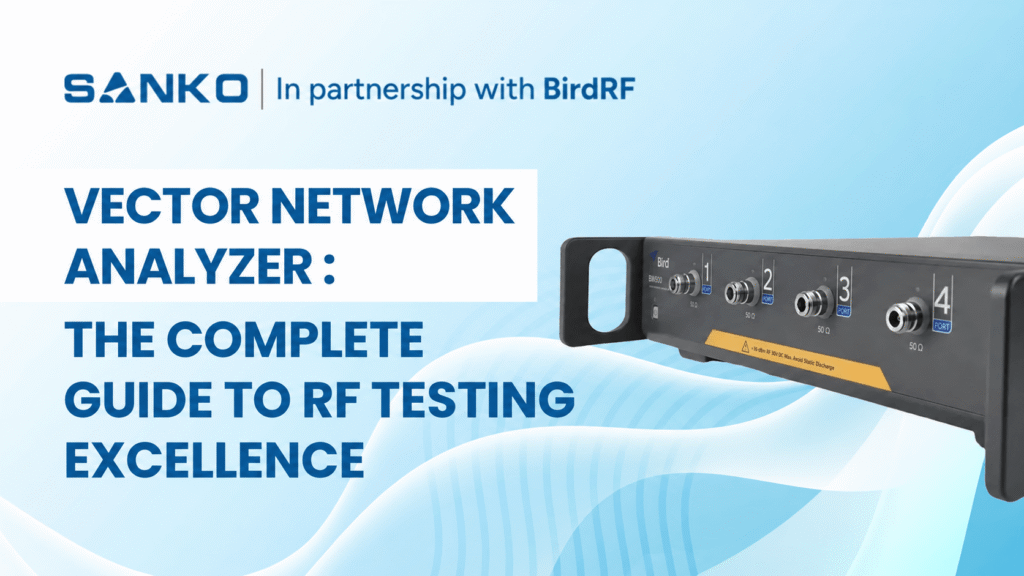
射频(RF)技术的发展要求精确的测量仪器必须与日益复杂的通信系统保持同步。矢量网络分析仪是技术进步的先锋,它是一种高性能仪器,在最新的射频工程和测试应用中无处不在。
什么是矢量网络分析仪?
Vector Network Analyzer (VNA) is a radio frequency (RF) test instrument that measures both the amplitude and phase of high-frequency signals as they reflect from or pass through a device under test (DUT).
It applies a known RF stimulus and measures reflection and transmission as S-parameters, including S11 and S21. Engineers use these results to evaluate antenna matching, filter insertion loss, amplifier gain and cable performance. Accurate measurements require calibration at the DUT connection point.
射频(RF)技术的发展要求精确的测量仪器必须与日益复杂的通信系统保持同步。矢量网络分析仪是技术进步的先锋,它是一种高性能仪器,在最新的射频工程和测试应用中无处不在。
了解矢量网络分析仪:超越基本射频测量
A vector network analyzer measures a device’s complex reflection and transmission response across frequency. Unlike a scalar network analyzer, which measures magnitude, a VNA also measures phase. This information helps engineers assess impedance matching, gain, loss and delay in RF components and systems.
In antennas, communications systems and RF circuits, amplitude and phase relationships help explain component performance. Vector measurements support research and development, production testing and suitable field-service applications, depending on the instrument and test setup.
当今的网络分析仪非常适合 S 参数测量,它描述了电气网络如何响应不同频率的信号。这种测量可用于鉴定滤波器、耦合器和天线等无源元件以及放大器和混频器等有源元件。
How Does a Vector Network Analyzer Work?
The VNA generates a controlled signal and sweeps it across a selected frequency range. Directional couplers separate incident, reflected and transmitted waves. Receivers compare these waves with a reference, and the instrument calculates the DUT’s magnitude and phase response.
The process follows four steps:
- Generate a known RF stimulus.
- Apply the stimulus to the DUT.
- Measure incident, reflected and transmitted signals.
- Calculate and display the response across frequency.
Understanding S11, S21, S12 and S22
S-parameters describe how signals reflect from or travel through a device. For a two-port DUT, four main parameters describe matching and transmission in both directions.
| 参数 | Measurement | Typical use |
| S11 | Input reflection | Antenna matching and input return loss |
| S21 | Forward transmission | Filter loss, cable loss and amplifier gain |
| S12 | Reverse transmission | Reverse isolation or transmission |
| S22 | Output reflection | Output matching and return loss |
For a passive filter, S21 shows the transmitted signal across the passband and stopband. S11 shows input reflection. Reviewing both helps distinguish poor matching from other causes of transmission loss.
射频矢量网络分析仪在各行业的应用
射频矢量网络分析仪已被多个行业广泛采用,每个行业都利用其独特的功能进行特定应用。在电信领域,这些仪器对于设计和测试基站设备、确保最佳信号传输和接收特性至关重要。5G 和新兴 6G 技术的复杂性不断增加,进一步提高了对高性能射频测量解决方案的需求。
在雷达系统开发、卫星通信设备测试和电子战系统鉴定中,航空航天和国防应用在很大程度上依赖于射频矢量网络分析仪。它们对各种无源和有源设备(包括滤波器、天线和功率放大器)的射频(RF)和微波元件分析至关重要。
The automotive industry has become another significant user of RF vector network analyzers, particularly with the advancement of connected vehicle technologies, automotive radar systems, and vehicle-to-everything (V2X) communication protocols. These applications require precise RF component characterisation to ensure reliable performance in challenging automotive environments.
USB 矢量网络分析仪的崛起:便携式高精度
A USB vector network analyzer uses a connected computer for its interface and measurement control. Professional PC-controlled models can support demanding RF measurements while reducing the space occupied by dedicated instrument displays and controls.
USB connectivity does not determine accuracy, frequency range or suitability. Professional laboratory instruments and hobbyist VNAs can differ considerably. Compare the specifications, calibration capabilities and supported measurements of the particular model.
USB 矢量网络分析仪通常通过 USB 接口连接到标准个人电脑,充分利用现代个人电脑的处理能力和显示功能。这种方法降低了仪器成本,同时通过专用软件应用程序为用户提供熟悉的界面和广泛的数据处理能力。
Portability depends on the complete setup, including the computer, power supply, cables and calibration accessories. For outdoor work, check battery operation, environmental limits and ruggedness rather than assuming every USB VNA is field-ready.
USB 矢量网络分析仪的主要优势
- Compact size – Saves bench space.
- PC integration – Simplifies viewing and saving results.
- Programmable control – Supports repeated test sequences
- Portable arrangement – Can move between workstations
- Software options – Can enable supported analysis functions
技术规格和性能指标
VNA specifications should be compared under conditions that reflect your application. Dynamic range, trace noise and speed depend on frequency, configuration and measurement settings. A headline figure does not describe performance in every operating condition.
| Specification | Why it matters | What to confirm |
| 频率范围 | Defines the bands you can measure | Required start and stop frequencies |
| Port count | Defines available measurement paths | Reflection, transmission or multiport needs |
| 动态范围 | Supports measurement of weak transmission | Performance at the required frequencies and settings |
| Trace noise | Affects small response changes | Specified IF bandwidth and averaging |
| Source power | Sets the stimulus applied to the DUT | Suitable range and adjustment capability |
| 测量速度 | Affects test throughput | Sweep time at the required accuracy |
| Calibration support | Establishes the reference plane | Suitable standards and methods |
IF bandwidth controls part of the receiver’s noise-versus-speed trade-off. A narrower setting can reduce noise but usually increases measurement time. Choose settings based on whether you need fast production screening or detailed component characterisation.
Frequency coverage varies widely among USB and benchtop VNAs. Some professional PC-controlled models reach microwave bands, while others serve lower-frequency applications. Check the datasheet and required options rather than choosing by instrument format alone.
校准和测量精度
使用任何矢量网络分析仪进行精确测量都需要适当的校准程序,以考虑测量系统中的系统误差。矢量网络分析仪通过纠正仪器、电缆特性、适配器和测试夹具中的系统误差来实现高精度测量。
标准校准程序包括用于同轴测量的短开口-负载-通过(SOLT)校准和用于特殊应用的穿透反射线(TRL)校准。现代仪器通常包括自动校准程序,可简化这一关键过程,同时确保测量的可重复性和准确性。
Calibration establishes a measurement reference plane. When a cable connects the VNA to the DUT, calibrating at the cable’s end helps account for its effects. Anything added beyond that reference plane can still influence the measured result.
| Calibration approach | Typical application |
| One-port open, short and load | Antenna reflection and input matching |
| Full two-port SOLT | Coaxial reflection and transmission measurements |
| TRL | Suitable fixture, transmission-line or on-wafer testing |
| Electronic calibration | Simplifying calibration with a compatible module |
Calibration reduces systematic errors but cannot eliminate every source of uncertainty. Noise, connector repeatability and changes after calibration can remain. Keep cables stable and use a suitable verification device to check that the setup behaves as expected.
Reassess calibration after changing cables, adapters or the test arrangement. Confirm that calibration standards match the connector type and frequency range. Calibration kits and electronic modules may be separate purchases.
For a deeper explanation, read our guide to practical VNA calibration and measurement techniques.
Vector Network Analyzer Tutorial: Your First Measurement
Begin with a simple task, such as antenna reflection or transmission through a cable. Define the operating band and the result you need before choosing the settings.
- Prepare the setup. Inspect connectors, select suitable cables and follow the manufacturer’s stabilisation guidance.
- Set the sweep. Choose start and stop frequencies covering the DUT’s operating band.
- Select the measurement. Use S11 for input reflection or S21 for forward transmission.
- Set test conditions. Choose appropriate source power, measurement points and IF bandwidth.
- Calibrate. Establish the reference plane at the intended DUT connection point.
- Connect and measure. Keep the calibrated arrangement stable.
- Review and save. Use markers to examine key frequencies and record settings with the results.
For transmission testing, connect the DUT between two test ports. For a simple antenna reflection measurement, connect the antenna at the calibrated port or cable end. Follow instrument and DUT limits, especially when testing active components.
Vector Network Analyzer Antenna Measurement
A VNA measures an antenna’s input reflection to evaluate impedance matching across frequency. Common displays include S11, return loss, VSWR and the Smith chart. Calibrate at the antenna connection point and measure across the intended operating band.
| Measurement | What it tells you |
| S11 | Reflection from the antenna input |
| Return loss | Reflected signal level relative to the incident signal |
| VSWR | Degree of impedance mismatch |
| Smith chart | Resistance and reactance across frequency |
| Impedance bandwidth | Frequency range meeting a defined matching limit |
For a passive antenna, a more negative S11 magnitude in dB means less reflection. Return loss expresses this relationship as a positive value. For example, S11 of −20 dB corresponds to 20 dB return loss.
| S11 magnitude | Return loss | Reflected power | Approximate VSWR |
| −10 dB | 10 dB | 10% | 1.92:1 |
| −15 dB | 15 dB | 3.20% | 1.43:1 |
| −20 dB | 20 dB | 1% | 1.22:1 |
These relationships follow the standard return-loss and VSWR calculations.
Use the antenna or system specification to decide whether a result is acceptable. These values describe matching, not a universal pass/fail threshold.
Good matching alone does not establish antenna gain, radiation pattern or efficiency. An antenna can accept power while losing some of it rather than radiating effectively. Those characteristics require additional measurements and a suitable antenna test arrangement.
The enclosure, mounting position and nearby objects can change antenna impedance. Test under conditions that represent the intended installation and keep the arrangement consistent when comparing results.
与现代测试系统集成
当代射频测试环境越来越需要能与自动测试设备 (ATE) 和生产线系统无缝集成的仪器。USB 矢量网络分析仪凭借其标准计算机接口和基于软件的控制系统,在这些应用中表现出色。
Both benchtop and PC-controlled VNAs may support automation. Check the model’s control interface, commands, drivers and software licences. Manufacturing plug-ins and advanced test functions are model-specific rather than standard features of every VNA.
编程接口,包括 SCPI(可编程仪器标准命令)兼容性,使工程师能够开发定制测试序列,并将矢量网络分析仪测量集成到更广泛的系统验证程序中。这种可编程性将这些仪器的用途从基本测量扩展到全面的系统鉴定。
Before automating, establish a repeatable manual measurement and define:
- Calibration and verification procedures.
- Sweep settings, source power and test limits.
- DUT identification and result storage.
- Actions for failed measurements or lost connections.
与传统台式分析仪的比较
Choose the instrument format around the working environment and required measurements. Benchtop, USB and handheld VNAs can serve professional applications, but their capabilities vary by model.
| 参数 | Benchtop VNA | USB or PC-controlled VNA |
| 界面 | Usually integrated display and controls | Host computer and software |
| Bench space | Dedicated instrument footprint | Compact hardware plus computer |
| 性能 | Depends on the model and options | Depends on the model and options |
| 便携性 | Depends on size and power needs | Depends on the complete setup |
| Automation | Available on supported models | Available on supported models |
| Upgrades | Hardware and software options vary | Hardware and software options vary |
Compare total setup cost, supported measurements and specified accuracy. Neither lower cost nor equivalent performance follows automatically from USB connectivity. Software upgrades can enable supported functions but cannot remove fundamental hardware limits.
VNA vs Spectrum Analyzer vs Antenna Analyzer
| Instrument | Main purpose | Example task |
| Vector network analyzer | Measures a DUT’s response to a known stimulus | Filter loss and antenna matching |
| Spectrum analyzer | Examines signal power across frequency | Interference and unwanted emissions |
| Cable and antenna analyzer | Supports installation and maintenance measurements | Feedline matching and fault location |
Some instruments combine these functions. Spectrum analyzers with tracking generators can perform certain response measurements, but phase measurement and calibration capabilities differ. Confirm which functions the instrument supports.
For field-testing considerations, see our guide to handheld spectrum and cable analyzers.
未来趋势和技术进步
矢量网络分析仪市场随着不断进步的技术要求和新兴应用而持续发展。扩大频率覆盖范围、改进动态范围和提高测量速度是整个行业当前的发展重点。
For buyers, practical developments include wider frequency coverage, multiport testing and stronger software integration. Assess each capability against your project rather than relying on broad claims about future technologies.
Software can expand supported analysis and automation functions. However, frequency coverage, receiver performance and other hardware characteristics still define the instrument’s measurement limits.
How to Choose a High-Frequency Network Analyzer for 6G R&D
Begin with the research band, DUT and required measurement. Different 6G research projects need different systems. A “6G-ready” description alone does not establish suitability.
- Frequency coverage: Confirm calibrated operation across the research band.
- Extension capability: Check whether compatible frequency extenders are required.
- Connections: Assess suitable connectors, waveguides or probes.
- Calibration: Establish the reference plane at the DUT.
- Performance: Check dynamic range and uncertainty at the intended frequencies.
- Measurement scope: Decide whether S-parameters are sufficient or additional instruments are needed.
Advanced component testing may involve a VNA, frequency extenders, controllers and signal-generation hardware. Evaluate the complete measurement system, including calibration and accessories, rather than the analyzer’s maximum frequency alone.
为您的应用选择合适的矢量网络分析仪
选择合适的矢量网络分析仪需要仔细考虑几个关键因素,包括频率范围要求、动态范围规格、端口配置和预算限制。在传统台式分析仪和 USB 解决方案之间做出选择,主要取决于具体的应用要求和操作限制。
For field testing, assess battery operation, ruggedness and the full setup’s portability. For laboratory and production work, prioritise measurement performance, repeatability and automation. A USB VNA can be suitable when its specifications and working arrangement match these requirements.
由于 USB 矢量网络分析仪兼具专业级性能和低廉的价格,越来越多的教育机构青睐于它。这些仪器为学生提供了使用专业射频工程中使用的相同测量原理的实践经验,同时又符合典型的教育预算。
| 应用 | Requirements to assess |
| Antenna matching | Operating band, reflection accuracy and one-port calibration |
| Cable and filter testing | Two-port capability, transmission accuracy and dynamic range |
| Amplifier testing | Source power, receiver limits and supported active-device functions |
| PCB components | Fixtures, calibration access and de-embedding |
| Multiport devices | Port count, switching arrangement and calibration workflow |
| Production testing | Speed, repeatability and programmable control |
Include calibration standards, suitable cables, adapters, software and any host computer in the quotation. Confirm which functions are included and which require additional licences or hardware.
For devices with several signal paths, explore multi-port and multi-band VNA measurements. For fixture-connected DUTs, read about VNA fixture simulation and de-embedding.
Common VNA Measurement Problems
Unexpected results can come from the DUT, test arrangement or settings. Check the setup before deciding that a component has failed.
- Trace changes when a cable moves – Cable stability, connector condition and calibration validity
- Results differ after reconnection – Connection repeatability and connector handling
- PCB component shows unexpected loss Fixture effects and reference-plane placement
- Noisy measurement trace IF bandwidth, averaging and received signal level
- Good antenna matching but poor range Feedline loss, radiation performance and interference
- Deep filter rejection reaches a flat floor Noise floor, leakage and available dynamic range
Where supported, time-domain analysis can help locate cable discontinuities. Distance-to-fault results also depend on settings such as cable velocity factor. Read our guide to distance-to-fault testing with a VNA.
Sanko: 您值得信赖的射频测试解决方案合作伙伴
When it comes to sourcing high-quality vector network analyzers and RF testing equipment, we are a reliable partner for engineers and organisations worldwide. Our comprehensive product portfolio includes both traditional benchtop and cutting-edge USB vector network analyzers from leading manufacturers, ensuring that our customers have access to the most advanced measurement technologies available.
我们深知,成功的射频项目取决于精确的测量和可靠的仪器。无论是在研究实验室、生产设施还是现场测试环境中,我们的技术专家都会与客户密切合作,为其特定应用确定最佳的矢量网络分析仪解决方案。
我们的承诺不仅限于产品销售,还包括全面的技术支持、校准服务和培训计划,帮助客户最大限度地利用其在射频测试设备上的投资。这种全面的方法可确保客户高效、准确地实现测量目标。
常见问题
Is an RF Network Analyzer the Same as a VNA?
An RF network analyzer is a broader description. A vector network analyzer measures magnitude and phase, while a scalar network analyzer measures magnitude. Check the supported measurements when comparing equipment.
Can a USB Vector Network Analyzer Replace a Benchtop VNA?
It can when its frequency coverage, accuracy, ports and measurement functions meet the application. USB describes the connection and working arrangement. Compare specific models and complete setups before choosing.
Can a VNA Locate a Fault in a Cable?
Some VNAs support time-domain or distance-to-fault measurements. These functions use reflection data to help locate discontinuities. Availability and setup requirements depend on the instrument and installed options.
Does Good Antenna Matching Guarantee Good Performance?
No. Return loss and VSWR describe matching, but do not establish gain, radiation efficiency or coverage. Additional testing may be necessary to assess the antenna’s overall performance.
What Information Should I Provide When Requesting a VNA Quotation?
Provide the DUT type, operating frequencies, required ports, measurements, accuracy needs and expected test volume. Include the working environment and existing accessories. This helps identify suitable vector network analyzer solutions and equipment for a complete setup.
立即提升您的射频测试能力
在不断进步的无线技术、不断提高的频率要求和不断增长的性能需求的推动下,射频工程领域正以前所未有的速度持续发展。无论您是在开发下一代通信系统、设计精密射频元件,还是在维护关键的无线基础设施,合适的矢量网络分析仪都能让您的项目成功与失败截然不同。
不要让过时的测量设备阻碍您的创新潜力。探索我们全面的矢量网络分析仪选择,从最适合现场测试的紧凑型 USB 解决方案,到专为要求最苛刻的应用而设计的高性能系统。我们的专家团队随时准备帮助您确定符合您的技术要求、预算限制和性能目标的理想测量解决方案。
准备好彻底改变您的射频测试能力了吗? 联系我们 了解我们最先进的 vector network analyzer 解决方案如何加速您的项目、提升您的测量水平,并在当今快节奏的射频市场中为您带来竞争优势。您的下一个突破,仅需一次测量。
 Chinese
 English
 Korean
 Japanese
 Spanish